
Hi Wonderful Readers,
I’m so delighted to feature one of my best writing friends today for our Kidlit Zombie Week post, the brilliant and ever-kind Ana Siqueira! If you haven’t heard about Kidlit Zombie Week – a week of collaboration, connection, and revision, check out here.
Without further ado, I hope you enjoy this enlightening revision post and head to our 6 Ladies and a MANuscript Twitter account for a great discussion about revision based on this fantastic post below.
What to Cut and What to Add – Finding and Keeping the Must-Haves – Guest Post by Ana Siqueira
Today I’m excited to be here for Kidlit Zombie Week to talk about things to add or remove from your picture books to make them stronger. I’ll use some examples from my journey and hope they help you with yours.
- ADD – FIND YOUR THEME
In my book, BELLA’S RECIPE FOR SUCCESS, the plot is about a girl trying to discover what she is good at. But the theme is about growth mindset: Everyone makes mistakes and that’s how we learn and grow.
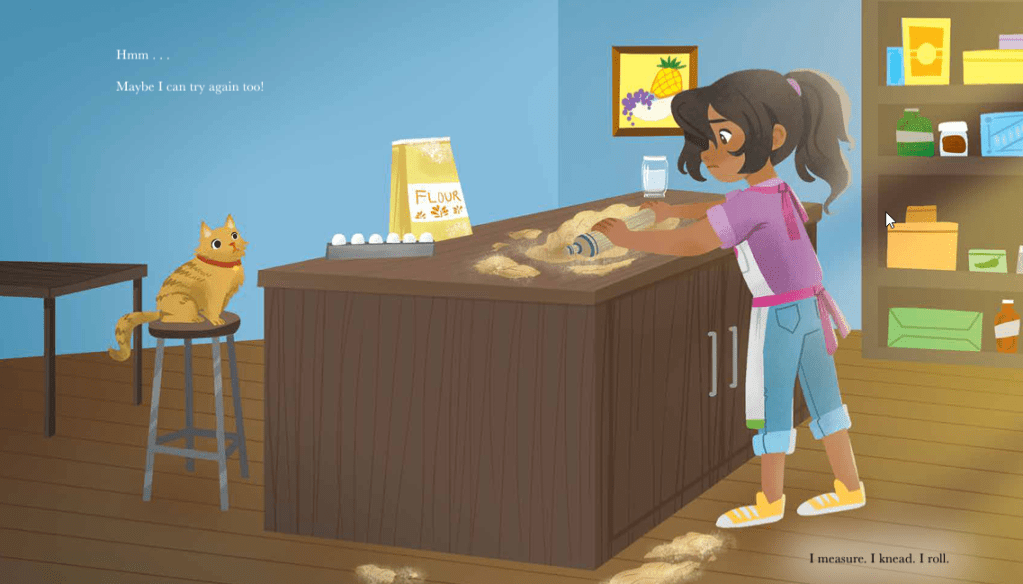
From BELLA’S RECIPE FOR SUCCESS, Words by Ana Siqueira, art by Geraldine Rodriguez
BELLA’S RECIPE FOR SUCCESS – Beaming Books. Ana Siqueira and Geraldine Rodriguez
For ABUELA’S SUPER CAPA, the plot is about a boy grieving when his abuela gets sick and can’t be his sidekick anymore. But the theme is “change is not all bad. And there are many adventures to have, even if they look a little different.” (HarperCollins jacket) And our abuelas will always be our superheroes.
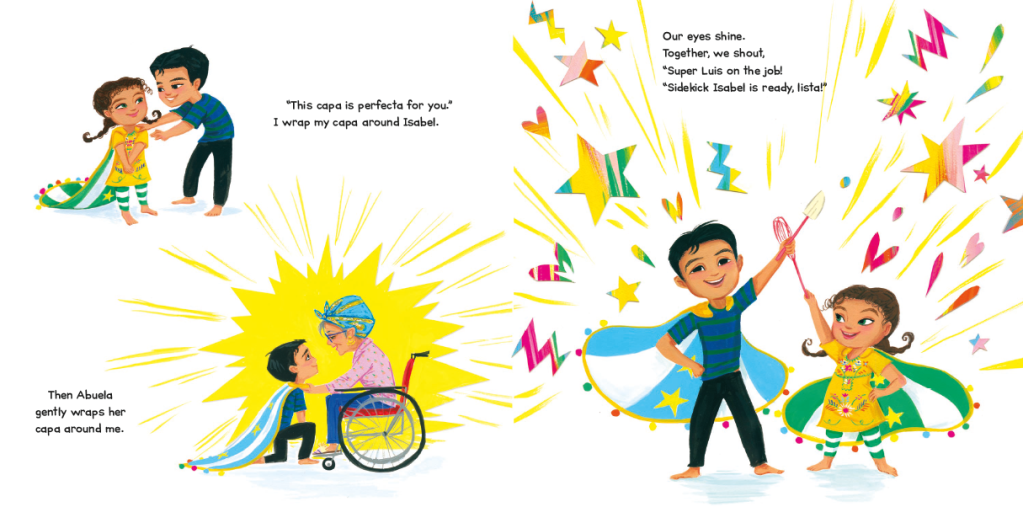
From ABUELA’S SUPER CAPA, Words by Ana Siqueira, art by Elisa Chavarri
IF YOUR BABYSITTER IS A BRUJA is about a girl scared of her new babysitter who comes over dressed up as a bruja on the night before Halloween. But it’s really about not judging anyone based on appearances. The bruja (is she really a bruja?) ended up being nice and super fun. I wish I had a babysitter like her.

From IF YOUR BABYSITTER IS A BRUJA, Words by Ana Siqueira, art by Irena Freitas
- CUT – REVISE, REMOVE, REPEAT.
Based on your theme, slay your darlings. Yes, they might be so poetic, funny, and special to you, but if it’s not related to your theme: KILL IT!
My theme in Bella is about making mistakes.
I can still add layers, but I should not add scenes that do not move the story forward and are not related to this theme.
For example, maybe I wanted to add a scene where Bella goes to the market to buy dulce de leche, sees a dog, and tells the readers she always wanted a dog.
Is this scene related to the theme? Nope. Is this scene moving the story forward? Nope. So, even if it’s the cutest dog on Earth, cut it from the story.
Cut all sentences and words not needed, even if you love them.
- ADD LAYERS
In Abuela’s Super Capa, my editor Luana Horry was super happy because there are a lot of layers (hooks) – It’s about grandma, illness, superheroes, family, siblings, grieving, and love.
So, if your story is about a boy climbing a mountain, how can you add layers? Nature, challenges, friendship, animals, resiliency, etc. You can think about layers, and add them, but be careful. Don’t overcomplicate. Try to add these organically so you don’t add scenes that don’t move the story forward and confuse the readers.
- REMOVE OVERCOMPLICATION
As I’ve mentioned above, don’t overcomplicate. That’s my tendency.
Check your manuscript and send it to critique partners. Are they all a little confused? Don’t think… “Well, they don’t understand me. My story is for geniuses only.” (I have thought like that before. Hahaha)
Just stop, read their feedback, let it sink in, and try to slay your manuscript again.
How can you make things simpler?
During my many calls with Lynne Marie (an amazing editor), she would show me where I was overcomplicating things.
Write your scenes, for example:
Scene 1: Bella watches her siblings being fabulosos and wonders what she is good at/ Scene 2: She tries gymnastics. Not fabulosa/ scene 3: she tries the piano, not fabulosa, etc.

From BELLA’S RECIPE FOR SUCCESS, Words by Ana Siqueira, art by Geraldine Rodriguez
Then, check for scenes that over complicate everything and do not move the story forward. If you remove it, despite breaking your heart, will the story be clearer?
- ADD CHARACTER’S AGENCY
Some agents and editors say this might be a rule to be broken. But most stories will be more fun if you add agency to your character.
When I was collaborating with my editor Alyza Liu, Simon & Schuster, on IF YOUR BABYSITTER IS A BRUJA, she requested something wise. The girl was imagining (or not) that her babysitter was a bruja, and she was reacting to everything the bruja was doing, such as dunking her in a cauldron and dropping her on a Twisted Torre. Alyza asked me to try to show the girl trying to solve the bruja problem. And then… The girl creates a magic potion, tries to get la bruja stuck on the slippery slide, and even tries to melt her with water (Wizard of Oz inspiration). And now the story is much more fun and active.
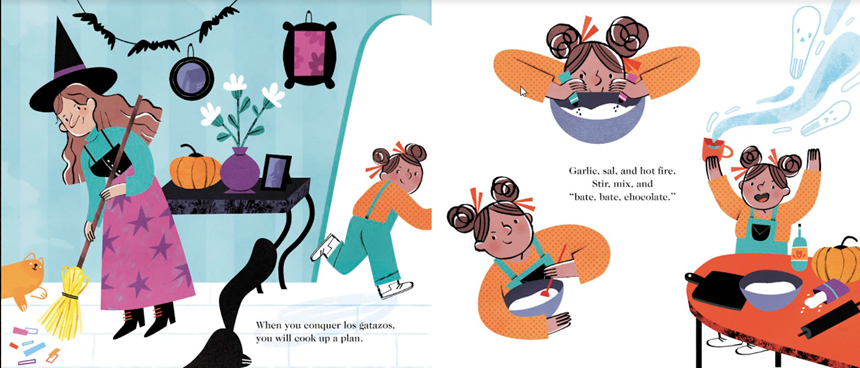
From IF YOUR BABYSITTER IS A BRUJA, Words by Ana Siqueira, art by Irena Freitas
- ADD POETIC DEVICES
Yes, your book does not need to be a rhyming book to be lyrical and rhythmic. When I wrote IF YOUR BABYSITTER IS A BRUJA, I read poems daily to train my brain. Also, I watched the wonderful videos of Renee La Tulippe.
There are so many poetic devices. My favorites: rhythm, alliteration, and onomatopoeia. A non-rhyming book full of poetic devices is The Most Magnificent Thing by Ashley Spires.
- REMOVE THE EXTRA ENDING SCENE
End where it is supposed to end. After you find the solution, don’t try to add one more paragraph. Maybe you can add one page with art only. Or you can add a twist.
For example, the boy climbs the mountain to find his lost puppy. He finds and hugs his puppy. The end. Don’t add a scene where they go down the mountain and say something such as: “Best friends will always find each other.”
And if your message is too much “on the nose.” REMOVE it.
You showed your readers that. You don’t need to say it.
You could add a sweet or twisted ending. Check below.
For example, in the story I just sold to Alyza Liu – IF YOUR ABUELO IS AN ASTRONAUTA – I wanted to include a scene with some lullaby singing. It was so sweet and heartfelt. But it was just adding complications unrelated to the theme or topic. So… I CUT IT.
- ADD A SWEET OR TWISTED ENDING
I’ve learned that most endings should either be
Awww, how cute.
Or What? Really?
You could add one more page after the boy finds the dog.
Maybe a sweet ending, with art only: They are sleeping, cuddled together.
Maybe a twisted ending: The cat disappeared, and they must restart a journey to find the cat. – Or more sinister: After he goes down the mountains, he stops to observe the dog and… He got the wrong dog.
(Of course, because I like happy endings, he’ll find his dog on the next page.)
- ADD A CHARACTER’S ARC (when applicable)
Not all the stories have arcs, but most do. So, if it’s applicable, think about the arc of your story. How does your character change from the beginning to the end?
For example, during an SCBWI conference, I had a critique with the Scholastic editor Orlando dos Reis. I showed him a story where a boy tried to conquer a monster. The monster changed and became friendly. But the boy didn’t change at all. He asked me if I could find a way to give the boy an arc. And I did. The boy, in the end, discovers his power is not in his strength but in being a good friend and caring. So, now my story has two arcs and it’s stronger.
- REMOVE THE TELLING
Many times, we show something and then tell, or tell something before showing.
For example, if you show Maria stomping and shouting, don’t say: Maria is angry.
Of course, most of the time, it’s not that obvious. But look for telling that’s not needed.
Sometimes, we think we need to explain what’s going on. Let the readers arrive at their conclusions by themselves.
Most of the time, telling is not needed.
- ADD ONE MORE PROBLEM
I loved reading the book The Plot Clock by Joyce Sweeney. (My agent)
Instead of having three acts, a story can have four acts.
You can check more about it here.
So, when you think all is solved, one more problem happens.
In BELLA’S RECIPE FOR SUCCESS, after she realizes it’s okay to make mistakes, she tries again and gets perfect polvorones cookies, but…
She burns the filling, the dulce de leche.
The characters can solve this problem quickly because they have learned their lesson already.
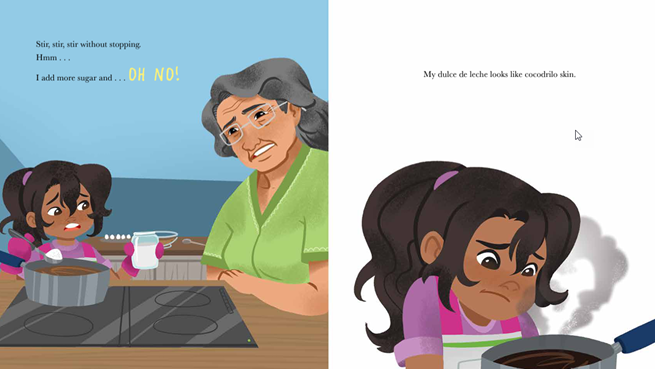
From BELLA’S RECIPE FOR SUCCESS, Words by Ana Siqueira, art by Geraldine Rodriguez
- ADD your experiences, but REMOVE what’s not important for the story, and ADD fiction.
It’s always fun and more heartfelt when your story is based on your experiences and culture. But be careful, unless your book is an autobiography, don’t try to write exactly what happened. Pick and choose what is important for the readers. Add fun and fiction to make it more relatable.
For example, IF YOUR BABYSITTER IS A BRUJA is based on a real story that happened to me. One day, my daughter started saying I was a witch because I didn’t allow her to go for the 1000th last dive in the ocean. This story happened many, many years ago. And I was not even a writer then. But when I wrote the story, I transformed it. First, the babysitter is the bruja, not the mom. Much more credible, right? Second, it happens at night when it’s almost Halloween. Spookier, right? And the girl is as sassy as my daughter, but she doesn’t shout out her suspicions. She tries to make this witch go away. More fun and action-packed? Get inspired by your experience, pour your feelings into it, but make changes as needed.
ABUELA’S SUPER CAPA is based on my son and my mom’s superhero role plays, but in this book, Abuela gets sick when Luis is a little boy. In real life, my mom got sick when he was an adult. We even added pets that are cupcake criminales.

Ana’s mom – Neila Siqueira – as Robin.
All my books have a little bit of me, my family, and my experiences.
- ADD TENSION
When applicable, try to add tension to your manuscript.
a. Write short sentences, filled with action.
b. Add page-turners by using ellipsis or until, then, etc.
c. Exaggerate the feelings and actions.
d. Use onomatopoeia.
14. KEEP your character’s dark moment. ADD a beat
When taking a class with Jim Averbeck, he taught us to add one more beat to the character’s dark moment. Let us feel their despair.
15. ADD HUMOR (when applicable)
Children are naturally funny. Try to think like them. What would a kid think or do in this situation? What would they say? How would they make a big deal out of small things?
In ABUELA’S SUPER CAPA, the book is about grieving. Abuela is sick and they can’t play together anymore. How could I add humor? Through art. Children will laugh at seeing the dog and the cat stealing cupcakes. And in the text, the boy calls him cupcake criminales.
16. Finally, ADD what you like, and CUT what you don’t.
You might get many suggestions from your critique partners/ editors, etc. Some suggestions you won’t like, but if you hear them many times, you might need to consider them. Some suggestions won’t be valid for you at all. Be flexible, and imagine what if you would try this. But in the end, you decide on what to add, keep, or cut.
I hope these tips will help you revive your zombie stories. I have many zombies buzzing on my laptop. Let me see if I can follow my advice. Good luck.
Wasn’t that wonderful?
Check out all the events for #KidLitZombieWeek July 3-7, 2023 here.
There are prizes for pitches and pledges! 🤩
And be sure to follow 6 Ladies and a MANuscript on Twitter for more great tips and discussions: @6and_MANuscript, head over to Twitter now and tell us which of these additionals or removals you’re excited about trying with your “dead” manuscript to bring it back to life!
Ana Siqueira is a Spanish-language elementary teacher and an award-winning children’s book author based in Tampa, Florida. Before Bella’s Recipe for Success (Beaming Books 2021) and If Your Babysitter is a Bruja (S&S 2022), and Abuela’s Super Capa/ La Supercapa de Abuela (HarperCollins 2023) she published children’s books in Portuguese in Brazil and in Spanish for the foreign language educational markets. Some other books are BOITATA: THE FIRE SNAKE (Capstone 2023), OUR WORLD BRAZIL (Barefoot 2023), ROOM IN MAMI’S CORAZON (HarperCollins 2024), LA MALA SUERTE IS FOLLOWING ME (Charlesbridge 2024), and others. anafiction.com
 Kaitlyn Leann Sanchez
Great advice, Ana! Thank you!
LikeLike
Love your advice, Ana! Thank you to you and Kaitlyn for this post!
LikeLike
You’re welcome. Good luck.
LikeLike
Wow, thanks Ana. That was a lot of advice. I’m going to have to go back and reread this and take notes. There was more than one place where it felt like you were speaking about some of my manuscripts specifically!
LikeLike
We all make the same “mistakes,” but as Bella says, “We can always try again. “
LikeLiked by 1 person
Ana – This was fabulous! I have so many things to try. Thank you!
LikeLike
You’re welcome. Good luck on your revisions.
LikeLike
Ana, you never fail to share wisdom! As an author myself, you’d think I know all this already (and to a great extent, I do). Yet reading your blog has inspired me to take a second, third, even tenth look at my work! Making a checklist of your ideas and girding myself up to kill those amazing, poetic, stunning senteces 🙂
LikeLike
Thanks.
LikeLiked by 1 person
So many great tips ! I really appreciate your examples too, Ana.
LikeLiked by 1 person
I am a teacher, so I must give examples. 😂
LikeLiked by 1 person
All these tips are great! So helpful! Thanks for posting.
LikeLike
Thanks, good luck on your revisions.
LikeLike
Such an extensive list, Anna! Great advice, and thanks for sharing!
LikeLike
Thanks. Time to revive your zombies.
LikeLiked by 1 person
“Well, they don’t understand me. My story is for geniuses only.” This is me more often than not. I usually come around though! Thanks for so many great ideas, Ana!
LikeLiked by 1 person
Right? 🤣🤣
LikeLike
Thank you for all of the great advice, Ana! You’ve inspired me to dust off some zombies! ❤
LikeLike
Happy for that. You can do it. You have the power.
LikeLiked by 1 person
Ana, I love and appreciate your terrific post with such insights! Thank you for all you do for this amazing kidlit community!!
LikeLike
Thanks. I hope you can revive some stories.
LikeLike
Thanks so much, Ana! This was full of rich, wonderful advice!
LikeLike
Excellent advice Ana. Everything makes sense. I can definitely see myself using your tips.
LikeLiked by 1 person
Great, good luck with your projects.
LikeLike
This post is PACKED with so much great info! Thanks for sharing, Ana!
LikeLike
You’re welcome. Good luck with your projects.
LikeLiked by 1 person
This is an excellent post, dear Ana — I am so thankful to have been able to be a part of your journey! Wishing you all the best! LM
LikeLike
You will always be part of my journey. Eternally grateful.
LikeLiked by 1 person
Awww, thank you. Me too (((HUGS)))
LikeLike
So much great advice. Thank you.
LikeLike
So much good advice here, Ana! Love the reminder to add one more beat to the dark moment!
LikeLike
Thanks for the tips, Ana. I also have a tendency to overcomplicate. Getting out those scissors to start cutting the extra details. 😊
LikeLike
Really great tips in this post Ana! So happy for all of your success!
LikeLike
So much revision wisdom here, Ana! I loved reading your post. Thank you for supporting #KidlitZombieWeek! We appreciate you.
LikeLike
So many zombies, so many options, so little time, LOL. I dream about the army of zombies coming after me in the dark. Clearly, I need to bring some of them over to my side. Thanks for these suggestions, Ana.
LikeLike
I’ve been trying to comment, and WordPress is acting like it doesn’t know who I am……
LikeLike
This is just what I needed to revise my zombie PB, Ana!
LikeLike
ANA: This is DEFINITELY a list of MUCH NEEDED helps to keep right next to us as we write and revise–and bring our ZOMBIE stories to life! THANK YOU for the INSPIRATION!
LikeLike
Thank you Ana. Lots of great advice! Thanks for sharing.
LikeLike
Great post Ana! Thanks for the reminders.
LikeLike
Hi Ana, it’s fabulosa to have such a great list of what to cut and what to keep. TY. I know some of these, but great to have them all together to create the perfect recipe for a story!
LikeLike
Trying again to post my thoughts here…Ana, this is a valuable mini picture book class. Thank you.
LikeLike
What a great collection of tips, thank you!
LikeLiked by 1 person